Tuesday, February 21, 2006

13.02

Peter's pence...

In the Roman Catholic Church, the annual voluntary laymen's contribution to the support of the pope. Formerly Peter's pence was a yearly tax of a penny levied by the Holy See on every household in England and elsewhere. The name derives from the fact that the Holy See is called the see of Peter.

The Columbia Encyclopedia, © Columbia University Press 2004

13.1

Behold the proof of Irish sense,
Here Irish wit is seen.
When nothing's left that needs defence,
Build a magazine.

--Jonathan Swift

12.34-35

With the toot of the flute, and the twiddle of the fiddle, O;
Hopping in the middle, like a herrin' on the griddle, O.
Up! down, hands aroun', crossing to the wall.Oh!
Hadn't we the gaiety at Phil the Fluther's Ball.

--Phil The Fluter's Ball, William Percy French (1854 - 1920)

12.27


Cork Hill (Castle)

Arbour Hill (Cemetery)

Constitution Hill (Broadstone Railway Station)

12.23

12.19-20

Revue des Deux Mondes

Fortnightly literary and arts review, first published in Paris in 1829. It was edited by François Buloz (1831-77), and among its contributors were Charles-Augustin Sainte-Beuve, Honoré de Balzac, Victor Hugo, Hippolyte Taine, and Ernest Renan. It was later edited by Ferdinand Brunetière (1893-1906). Publication was suspended in 1944, but it re-appeared in 1948, re-named La Revue de Littérature, Histoire, Arts et Sciences des Deux Mondes.

Crystal Reference Encyclopedia (2001)

12.18

Queen Anne's Bounty

A fund established by Queen Anne in 1704.

She surrendered her revenues from first fruits and tenths to the fund, which was to be used for the benefit of poorer beneficed clergy. In the 19th century the fund also received parliamentary grants and private donations. In 1948 the administration of the fund passed to the Church Commissioners.

Market House Books Dictionary of British History, © Market House Books Ltd 1987

11.34-35

Sarah...

In the Bible, the wife of Abraham and mother of Isaac

The American Heritage® Concise Dictionary, Third Edition, 1994

11.28

Slán!

farewell; healthy personadjective: safe, secure; sound; intact; whole; (MUS) perfect; slán a fhágáil ag duine/chur le duine to say goodbye to sb; teacht slán as rud to survive sth, pull through sth; slán sábháilte safe and sound; unscathed; gura slán don am sin those were the days; slán a bheas mé if God spares meexclamation, interjection: goodbye; slán go fóill! so long!; slán leat!, slán agat! cheerio; farewell; slán codlata! good night!

Collins Irish Dictionary (1997)

11.16

Nebo, Mount...

2,625 ft (800 m) high, N Jordan. In the Bible, Moses viewed the Promised Land from there before his death.

The Columbia Encyclopedia, © Columbia University Press 2004

11.13


armitides toonigh...

11.10

Monday, February 20, 2006

11.9

Lalla Rookh (An Oriental Romance): "Paradise and the Peri...

Four narrative poems, with a connecting tale in prose, by Thomas Moore, published in 1817. In its day it was one of the most popular examples of the Orientalism which Moore's friend Byron also helped to make fashionable.

Lalla Rookh, the daughter of the Emperor Aurungzebe, journeys from Delhi to Cashmere, where she is to be married to the King of Bucharia. The journey is enlivened by stories told by Feramorz, a young poet from Cashmere, who joins her retinue. ‘The Veiled Prophet of Khorassan’ tells of the tragic love affair of Zelica and Azim. In ‘Paradise and the Peri’ a peri, or child of a fallen angel, finally gains admission to paradise by bringing the tear of a repentant criminal to its gates. ‘The Fire-Worshippers’ tells another tragic love story, about Hafed, a young Gheber or fire-worshiper, and Hinda, daughter of the emir Al Hassan of Arabia, who crushes the Ghebers. In ‘The Light of the Haram’ Nourmahal wins back the love of her husband, Selim, with a magic song she learns from the enchantress Namouna. The self-important chamberlain Fadladeen vents his irritation at the mishaps of the journey by criticizing the stories told by Feramorz, but Lalla Rookh falls in love with him and eventually discovers that he is none other than her prospective husband, the King of Bucharia.

The Cambridge Guide to Literature in English, © Cambridge University Press 2000

11.05

nubes...

cloud; (figurative) gloom; veil.

Collins Latin Dictionary, © HarperCollins Publishers, 1997

11.04

Nixe

Plural: Nixen water-sprite, water-nymph, nix(ie). (mit Fischschwanz) mermaid; (scherzhaft: = Badenixe) bathing belle.

Collins German Dictionary, © HarperCollins Publishers 1999

11.03

Thor (Norse myth)

The god of thunder, depicted as wielding a hammer, emblematic of the thunderbolt. [Old English Thr, from Old Norse thrr thunder].

Collins English Dictionary, © HarperCollins Publishers 2000

10.36

pigeon pair...

Colloquial: a son and a daughter. [so called since pigeons usually produce one male and one female per laying]

The Macquarie Dictionary (2003)

10.35

Rothschild...

The name is associated with the great wealth of the international banking family of Rothschild, whose name derives from the red shield by which their parent house at Frankfurt was known. The family banking business really stems from the activities of Mayer Amschel Rothschild (1744-1812), who made a fortune during the Napoleonic Wars. His five sons separated, extending the business throughout Europe. Nathan Mayer Rothschild (1777-1836) established a branch at London in 1798 and made a financial scoop by his advance knowledge of the defeat of Napoleon Bonaparte at Waterloo in 1815. His son Lionel Nathan (1808-79) was best known for his work for Jewish emancipation in Great Britain. Lionel's son Nathan Mayer (1840-1915) was made a baron in 1885 and was the first Jew to be admitted to the House of Lords. Nathan's son Lionel Walter (1868-1937), the 2nd Baron Rothschild, was a noted collector and taxonomist. The 3rd baron, Nathan's grandson, was Nathaniel Mayer Victor Rothschild (1910-90), a zoologist and administrator. His own son, Nathaniel Charles Jacob (b.1936), 4th Baron Rothschild, largely assumed his father's administrative mantle. Jacob's heir is Nathaniel Philip Victor James Rothschild (b.1971).

Brewer's Dictionary of Phrase and Fable, Millennium Edition (2002)

10.31

Fomorians (or Fomhoire)...
Irish ‘underworld spirits’

In Irish legend, a race of demonic beings who lived in Ireland and fought off successive waves of settlers. They were finally expelled by the Tuatha Dé Danann (people of the goddess Danu) in the second Battle of Muighe Tuireadh (Moytirra). Their most prominent leader was Balar of the Evil Eye, killed by Lugh.

The Hutchinson Encyclopedia, Helicon, © Helicon Publishing Limited 2001

10.30

Piltdown man...

Name given to human remains found during excavations (1908-15) at Piltdown, Sussex, England, by Charles Dawson. The find led to much speculation and argument. Since they were found with remains of mammals of the Lower Pleistocene epoch, they were supposed to belong to a Piltdown man who lived 200,000 to 1,000,000 years ago. Many scientists doubted the whole proposition. They were justified when fluorine tests showed in 1950 that the Piltdown fossil was no more than 50,000 years old. X-ray analysis proved that the jaw was from a chimpanzee; further tests demonstrated conclusively that the jaw and tooth were of modern origin.

There has been much speculation concerning who was responsible for the hoax: Dawson; Arthur Smith Woodward, the paleontologist who identified the fossils as hominid remains; Pierre Teilhard de Chardin, who was present during some of the excavations; Sir Arthur Conan Doyle, who lived nearby and knew Dawson; and others. In 1996, on the basis of evidence found in a trunk in the British Museum, it was suggested that the zoologist Martin A. C. Hinton planted the remains to embarrass Woodward

Columbia University Press 2004

10.28

The Three Ravens
Thomas Ravenscroft, 1583-1633

There were three ravens sat on a tree,
Down a down, hey down, hey down
They were a black as black might be,
With a down.
The one of them said to his mate.
"Where shall we our breakfast take?"
With a down, derry, derry, derry down, down

10.27


Castletown House...

Celbridge, County Kildare, Ireland's finest Palladian country house, is an imposing building built in 1722 for William Connolly, the Speaker of the Irish House of Commons. The main block was designed by Italian architect by Alessandro Galilei and the wings were added by Edward Lovett Pearce in 1724.

The house was inherited by Tom Connolly in 1758 and the interior decoration was finished by his wife Lady Louisa (great-grand-daughter of Charles II of England and Louise de Keroualle) during the 1760s and 1770s. Much of the work was carried out to designs of William Chambers.

Two particular features of Castletown is the Long Gallery, an 80 foot long room decorated in the Pompeian manner in blue and gold and the main staircase, which is cantilevered and made of white Portland stone.

-Wikipedia

10.19


The Battle of Busaco 1810.... (again)

10.5

Leipzig, Battle of (19 October 1813)

The climax of Napoleon's campaign in Germany. It is also known as the Battle of Nations for the numbers involved: 370,000 Russian, Prussian, Swedish and Austrian troops; 198,000 French troops. It was Bonaparte's first major defeat on a battlefield. His retreat ended with his abdication in 1814.

Andromeda Encyclopedic Dictionary of World History, © Andromeda 2001

10.2

Jackson, Stonewall (Thomas J.; 1824-63)

Confederate general during the Civil War

Jackson won the name Stonewall for his determined stand against the Union forces at the first Battle of Bull Run in 1861. During the Shenandoah Valley campaign of 1862, he displayed his outstanding talent for strategy and military leadership. He led troops in the first and second Battles of Bull Run, Fredericksburg, Seven Days' Battles, and Chancellorsville, all Southern victories. Jackson, like his Union counterpart William Tecumseh Sherman, pioneered the use of destructive war against the enemy's economic and agricultural resources and civilian population. He was accidentally shot by one of his own troops after the Battle of Chancellorsville and died a week later.

The Great American History Fact-Finder (1993)

10.2


Cape of Good Hope...

10.1

Taffy:

A Welshman, from Davy (Dafydd, 'David'), a common name in Wales. Perhaps it is best known among the English from the (now derogatory) rhyme alluding to the days of border cattle raids.

Taffy was a Welshman,
Taffy was a thief,
Taffy came to my house
And stole a leg of beef.

Brewer's Dictionary of Phrase and Fable, Millennium Edition (2002)

9.36

De Valera, Eamon (1882 - 1975)

Irish statesman, b. New York City.

He was taken as a child to Ireland. As a young man he joined the movement advocating physical force to achieve Irish independence and took part in the Easter Rebellion of 1916. He was sentenced to life imprisonment (escaping execution because he was a U.S. citizen) but was released under a general amnesty in 1917. Elected that same year a member of Parliament and president of Sinn Féin, De Valera was arrested again in May, 1918. However, he escaped from prison (Feb., 1919) and went to the United States, where he raised funds for Irish independence. In the meantime he had been elected president of Ireland by the Dáil Éireann, the revolutionary parliament that had declared the country independent. In 1920, when he returned to Ireland, the country was in a state of virtual war against British rule. In 1921 the British government opened the negotiations that led to the establishment of the Irish Free State. De Valera, however, repudiated the final treaty because it excluded Northern Ireland and required Irish officeholders to swear allegiance to the British crown. He resigned from the Dáil in Jan., 1922. Nominal leader of the republican intransigents, De Valera greatly deplored the period of civil war that followed. He maintained his opposition to the government, however, and did not enter the Dáil with his party, Fianna Fáil, until 1927. In the general election of 1932 his party gained control of the Dáil, and De Valera became head of the government. He immediately abolished the oath of allegiance and refused to pay land annuities to Britain. A tariff war followed that was not ended until 1938. In 1937, De Valera introduced a new constitution declaring Ireland a fully sovereign state. He kept Ireland neutral throughout World War II, refusing to let the British use southern Irish ports and vigorously protesting Allied military activity in Northern Ireland. Fianna Fáil was defeated in the election of 1948, but De Valera returned as prime minister with independent support (1951-54) and with an absolute party majority (1957-59). Hampered by failing vision, in 1959 he moved to the less demanding office of president of the republic, to which he was reelected in 1966. He retired in 1973.

The Columbia Encyclopedia, © Columbia University Press 2004

9.35-36

della Porta, Giambattista (c. 1535 - 1615)

Italian natural philosopher, crytographer, and dramatist

After a period of study and travel throughout Europe, Porta returned to his native Naples where he published his Magia naturalis (1558; translated as Natural Magick, 1658). An immensely successful work (some twenty-seven editions are known), it distinguished between the magic of sorcery, which della Porta rejected, and natural magic. Under this latter term he included familiar yet mysterious phenomena taken from such fields as magnetism, hydraulics, optics, and chemistry, and sought to explain them in terms of attractions, sympathies, fascinations, and antipathies. The book also contains one of the earliest descriptions of the camera obscura. More original, although less well known, is his De furtivis literarum (On Secret Writing; 1563), a work of cryptography in which he provided solutions to a number of simple polyalphabetic ciphers. His Phytognomonica (1589) expounds the doctrine of signatures. Della Porta was also a leading figure in two early scientific societies. He helped to establish in Naples in 1560 the Academia secretorum naturae, the first such modern society, and in 1610 he became a member of Cesi's Accademia dei Lincei in Rome. In addition, from 1589 onwards, della Porta also published some twenty plays in prose and verse, some of which were translated in England and France.

Market House Books Encyclopaedia of the Renaissance, © Market House Books Ltd 1987

9.33

Marathon

A long-distance race, named after the Battle of Marathon (490 BC), the result of which was announced at Athens by an unnamed courier who fell dead on his arrival, having run nearly 23 miles (37 km). This runner is sometimes cited as Pheidippides (or Philippides), who actually ran from Athens to Sparta to seek help against the Persians before the battle.
In the modern Olympic Games the Marathon race was instituted in 1896, the distance being standardized at 26 miles 385 yards (42.195km) in 1924.

Brewer's Dictionary of Phrase and Fable, Millennium Edition (2002)

9.32

Bismarck, Prince Otto Eduard Leopold von.
Called the Iron Chancellor. (1815 - 1898)

Creator and first chancellor of the German Empire (1871-1890). Instrumental in victory over Austria (1866) and the creation of the North German Confederation (1867), he instituted during his chancellorship sweeping social reforms by which he sought to stop the advance of German socialism.

The American Heritage Dictionary of the English Language, © Houghton Mifflin Company 2003

9.30

Tipperary

The perennially popular song 'It's a Long Way to Tipperary' is inseparably associated with the First World War. The music is credited to Jack Judge, of Oldbury, Birmingham, and the words to Harry Williams of Temple Balsall, Solihull. Judge subsequently claimed that he wrote both words and music, the credit to Williams being made in repayment for a loan. The song was actually composed one day early in 1912 at the New Market Inn in Stalybridge, Manchester, and sung by Judge at the Grand Theatre that evening. It was popularized in the music hall by Florrie Forde in a pantomime of 1914 and tells of an Irishman on a visit to London who longs to return to his homeland and his girl despite the lure of the legendary streets paved with gold.

It's a long way to Tipperary,
It's a long way to go;
It's a long way to Tipperary,
To the sweetest girl I know!
Goodbye, Piccadilly,
Farewell, Leicester Square;
It's a long, long way to Tipperary,
But my heart's right there!

Brewer's Dictionary of Modern Phrase and Fable (2002)

9.29

Battle of Bunker Hill...

In the American Revolution, June 17, 1775. Detachments of colonial militia under Artemas Ward, Nathanael Greene, John Stark, and Israel Putnam laid siege to Boston shortly after the battles of Lexington and Concord. However, Thomas Gage, British commander in the city, made no attempt to break the siege until he was reinforced (in May) by troops led by William Howe, Sir Henry Clinton, and John Burgoyne. The Continental forces learned of the British plan to take the heights of Dorchester and Charlestown, and William Prescott was sent to occupy Bunker Hill outside Charlestown. Prescott instead chose the neighboring Breed's Hill to the southeast, but the engagement that ensued has become known as the battle of Bunker Hill. Howe was ordered to attack the American position, and after two slaughterous failures a third charge dislodged the Americans, who had run out of powder. The British victory failed to break the siege, and the gallant American defense heightened colonial morale and resistance.

The Columbia Encyclopedia, © Columbia University Press 2004

9.28

Austerlitz, Battle of (2 December 1805)

A tactical triumph for Bonaparte and the decisive battle of the War of the Third Coalition, fought in Moravia, between the French and Austro-Russian armies. Bonaparte smashed the allied center, forcing the Austrians to surrender and the Russians to flee. The resulting peace at Pressburg (1805) gave him control of most of Germany.

Andromeda Encyclopedic Dictionary of World History, © Andromeda 2001

9.27

Le mot de Cambronne...

Fr - When General Cambronne was asked to surrender at Waterloo, he is reported to have said Merde!-a mildly indecent expletive. His response was altered by popular accounts to read, La garde meurt ... (q. v.)

Dictionary of Foreign Phrases and Abbreviations, © Kevin Guinagh 1983

9.26


The Battle of Toulouse, 10 April 1814. The last major battle of the Peninsular War, fought between the British and Spanish forces under the command of the Duke of Wellington and the French forces under Marshal Soult.

The Wars of Wellington, a narrative poem. ...With ... engravings coloured ...
By: Syntax, Doctor; Illustrator: Heath, W; Stadler, J.C
London, 1819

9.25

Solferino...

Village, Lombardy, N Italy, near Mantua. There, on June 24, 1859, the French and Sardinians fought a bloody battle with the Austrians (see Risorgimento). Although the battle resulted in no clear decision, the Austrians withdrew to their strategic fortresses. Napoleon III, shocked by the huge losses and aware of the difficulties of continuing the war, soon afterward met Emperor Francis Joseph of Austria at Villafranca di Verona, where a preliminary peace was arranged. By a coincidence, J. Henry Dunant, the Swiss philanthropist, was present at the battle, which he described in Un Souvenir de Solférino. His experience in witnessing the battle later inspired him to promote the Red Cross (founded 1864).

The Columbia Encyclopedia, © Columbia University Press 2004

'The Emperor Napoleon III at the Battle of Solferino' Supplement to The Illustrated London News February 1860 Copyright ©2000, The British Library Board

9.24

floddens...

Flodden:

Field, Northumberland, N England, just across the border from Coldstream, Scotland. It was the scene of the battle of Flodden Field (1513), in which the English under Thomas Howard, 2d duke of Norfolk, defeated the Scots under James IV, who was killed.

The Columbia Encyclopedia, © Columbia University Press 2004

9.24

Camel, Battle of the...

A decisive engagement fought in 656 near al-Basra between Caliph Ali and ‘A’isha, the widow of Muhammad, and her supporters, who rebelled against Ali after the murder of Uthman, the previous caliph. Ali was victorious when the camel ridden by ‘A’isha was hamstrung and she was captured.

Andromeda Encyclopedic Dictionary of World History, © Andromeda 2001

9.21

Busaco, Battle of

In the Peninsular War, battle between English and Portuguese armies under the Duke of Wellington and the French under Marshal André Masséna 27 September 1810. Wellington bought the British a little more time in delaying the French invasion of Portugal and reduced the enemy's force.

Masséna had invaded Portugal and Wellington was falling back before him toward the lines of Torres Vedras, protecting Lisbon. Upon reaching the heights of Busaco, a ridge about 45 km/28 mi northeast of Coimbra, Wellington decided to offer resistance. The French had little opportunity for tactical surprise and merely made a series of head-on assaults against the British line. They were beaten off with heavy losses, the engagement was quickly over, and the British resumed their retreat, leaving the French to follow.

The Hutchinson Encyclopedia, Helicon, © Helicon Publishing Limited 2001

9.21


Tara...

The original residence of the high kings of Ireland in County Meath. There are many archeological remains of Tara's early historic period - mainly forts and burial mounds. Tara was chiefly important as a political center from the 3rd to the 6th centuries AD.

Andromeda Encyclopedic Dictionary of World History, © Andromeda 2001

9.20

Indulgences

Medieval documents bearing the seal of the Pope or of a bishop and granting the recipient remission of punishment in the next world for sins committed in this. They were freely sold in the Middle Ages by licensed `Pardoners', and were an easy way for the Church (and also for the pardoners) to raise money. Reformers such as the Englishman Wycliffe and the German Luther were fiercely critical of them. Chaucer made grim comedy of them (Pardoner's Tale) and his contemporary Langland regarded them sceptically (Piers Plowman, Passus VII).

Bloomsbury Dictionary of English Literature, © Bloomsbury 1997

9.20

Hundred Days, the (March 1815 - June 1815)

Bonaparte's return to power after his escape from exile in Elba. After his defeat at Waterloo he was exiled to the remote island of St Helena.

Andromeda Encyclopedic Dictionary of World History, © Andromeda 2001

9.20

parson's- (or pope's- or bishop's-) nose:

The rump of a chicken or other fowl; more common in the nineteenth century than in the present ecumenical age. An epicurean morsel-a parson's nose (Henry Wadsworth Longfellow, Hyperion, 1839). The papal form may be the oldest; it was included by Capt. Francis Grose in the 1788 edition of his Classical Dictionary of the Vulgar Tongue. The French have a similar expression: le bonnet d'évêque, bishop's cap. See also drumstick.

Dictionary of Euphemisms and Other Doubletalk, © 1995 by Hugh Rawson

9.16

Battle of Stamford Bridge

Village, Humberside, N England, 8 mi. (13 km.) ENE of York; scene of battle 1066 in which English King Harold II defeated his brother Tostig and Harold Haardraade, king of Norway, Tostig's ally, just before battle of Hastings.

Copyright © 2001 by Merriam-Webster, Incorporated

9.13

Battle of Salamanca...

40 58N 5 40W A city in central Spain, in Salamanca province. During the Peninsular War the battle of Salamanca was fought here on 22 July, 1812, in which Wellington secured a decisive victory over the French. An intellectual centre of Renaissance Europe, Salamanca remains an important cultural centre with a university (founded 1218). Its notable buildings include two cathedrals and it has a fine Roman bridge. Population (1995 est): 167 316.

The Macmillan Encyclopedia, © Market House Books Ltd 2003

9.8

Cotton, Edward.
A voice from Waterloo; a history of the battle fought on the 18th June 1815.
IMPRINT London, G. B. Green, 1849.

Friday, February 17, 2006

9.7

Agincourt

Modern French Azincourt, village, Pas-de-Calais dept., N France. There, on Oct. 25, 1415, Henry V of England defeated a much larger French army in the Hundred Years War (1337-1453). His success, which was due mainly to the superiority of the masses of English longbow men over the heavily armored French knights, demonstrated the obsolescence of the methods of warfare of the age of chivalry. The victory enabled the English to conquer much of France. The battle is the central scene of Shakespeare's drama Henry V.

The Columbia Encyclopedia, © Columbia University Press 2004
Laplante, Charles, d. 1903 -- Engraver

9.6

Fontenoy, Battle of

In the War of the Austrian Succession 1745, French victory under Marshal Maurice de Saxe over a combined British, Dutch, and Hanoverian army under the Duke of Cumberland on 11 May 1745 at a village in Hainaut province, Belgium, 8 km/5 mi southeast of Tournai.
The Allied army of about 50,000 troops was aiming to relieve Tournai, then under siege by the French, but at Fontenoy came up against a de Saxe holding a strong position with about 70,000 troops which blocked their advance. The attack opened with an abortive Dutch assault on the French centre. The British and Hanoverian infantry then advanced and a general melee ensued, culminating in a sudden attack by an Irish brigade under French command. The Allied square defence broke but they were able to retire in good order, although they lost some artillery.

The Hutchinson Encyclopedia, Helicon, © Helicon Publishing Limited 2001

9.6


Napoleon in the campaign of France 1814, by E. Meissonier,
from "A History of the Nineteenth Century, Year by Year," Edwin Emerson, Jr., 1900.

Pause

Fieldgaze thy tiny frow...

9.1-2

9.1

Philippi, Battle of

(42 BC) The decisive battle in N Greece in which Antony and Octavian (later the Emperor Augustus) defeated Brutus and Cassius, and thus avenged the murder of Julius Caesar.

Crystal Reference Encyclopedia (2001).

8.36

There drew he forth the brand Excalibur,
And o’er him, drawing it, the winter moon,
Brightening the skirts of a long cloud, ran forth
And sparkled keen with frost against the hilt:
For all the haft twinkled with diamond sparks,
Myriads of topaz-lights, and jacinth-work
Of subtlest jewellery.

Alfred, Lord Tennyson
, Morte D'Arthur

8.35


again...

8.28


Delia/Artemis

8.28

Delian League...

A confederacy of Greek city states formed in 478 BC during the Greek-Persian Wars under the leadership of Athens. Members met on the sacred island of Delos, voted on policy, and contributed funds assessed by Aristides the Just. After the peace between Greece and Persia (c. 450) Athens regarded its allies as subjects. The League treasury was moved to Athens and secession was punished as revolt. The League was disbanded after Athens' defeat (404) in the Peloponnesian War but was revived in defence against Sparta in 378, lasting until the defeat (338) of Athens and Thebes at Chaeronea.

The Macmillan Encyclopedia (2003).

8.28

All of them arminus-varminus...

Teutoburg Forest or Ger. Teutoburger Wald:

Range of hills, Lower Saxony and North Rhine-Westphalia, W Germany, S of Osnabrück; highest point ab. 1530 ft. (466 m.). Scene of battle 9 AD in which German tribes under Armin defeated Roman legions under Gen. Publius Quintilius Varus establishing Rhine as German-Latin border.

Merriam-Webster's Geographical Dictionary (2001).

8.22

Boyne:
A river of eastern Ireland flowing about 113 km (70 mi) to the Irish Sea. In the Battle of the Boyne on July 1, 1690, the armies of King William III defeated the forces of James II, who fled to France.

The Houghton Mifflin Dictionary of Geography (1997).

8.21

8.20-21

Peloponnesian War...

Struggle between Sparta and Athens, and their allies, that lasted from 431 until the defeat of Athens in 404 BC. Neither side had the means to destroy the other, but Athens was weakened by the losses of the Sicilian expedition (415-413 BC) and Sparta was strengthened by Persian support. Sparta's final naval victory at Aegospotami (405 BC) broke Athens' link with its Black Sea grain supplies and led to its surrender.

Andromeda Encyclopedic Dictionary of World History (2001).

8.19

Magna Carta...
A list of rights and privileges that King John of England signed under pressure from English noblemen in 1215. It established the principles that the king could not levy taxes without consent of his legislature, or parliament, and that no free man in England could be deprived of liberty or property except through a trial or other legal process.

The New Dictionary of Cultural Literacy, Third Edition. 2002

8.19

Quatre-Bras.... battle of (16 June 1815)
The battle in which the British, under Wellington, defeated the French, under Marshal Ney. Waterloo followed two days later.

-Dictionary of British History (1999)

8.18


E. Cobham Brewer 1810–1897. Dictionary of Phrase and Fable. 1898.

Iron Duke (The)

The Duke of Wellington was so called from his iron will. (1769–1852.)

Wednesday, February 15, 2006

8.15-17


Wellington & Copenhagen...

Wellington, duke of...

Arthur Wellesley, a British general of the nineteenth century, revered in his country as the victor over the emperor Napoleon Bonaparte at the Battle of Waterloo.

Wellington is known for allegedly saying the Battle of Waterloo was won on the playing fields of Eton. Eton is a famous English boarding school for boys. Wellington's statement emphasizes the effect of people's moral training and breeding on their later life.

The New Dictionary of Cultural Literacy, Houghton Mifflin (2002)

8.14

In silence they drove along Phibsborough road. An empty hearse trotted by, coming from the cemetery: looks relieved.

Crossguns bridge: the royal canal.


Water rushed roaring through the sluices. A man stood on his dropping barge between clamps of turf. On the towpath by the lock a slacktethered horse. Aboard of the Bugabu.

-Hades

8.14

Saloos...

The Battle of Loos was one of the major British offensives mounted on the Western Front in 1915 during World War I. The battle was the British component of the combined Anglo-French offensive known as the Second Battle of Artois. General Douglas Haig, then commander of the British First Army, directed the battle however his plans were limited by the shortage of artillery shells which meant the preliminary bombardment, essential for success in the emerging trench warfare, was weak. The British also released 140 tons of chlorine gas with mixed success—in places the gas was blown back onto British trenches.

The battle opened on September 25 and the British were able to breakthrough the weaker German trenches and capture the town of Loos. However the inevitable supply and communications problems and the late arrival of reserves meant that the breakthrough could not be exploited. When the battle resumed the following day, the Germans were prepared and repulsed attempts to continue the advance. The fighting subsided on September 28 with the British having retreated to their starting positions.

Charles Sorley, a British poet, died in this battle, as did Rudyard Kipling's son, John. Fergus Bowes-Lyon, brother to the Queen Mother, was also killed in the early stages of the battle.

In another interesting turn of events during the battle of Loos, ten thousand inexperienced British troops were sent in a frontal charge against German positions.

-Wikipedia

8.8

Kathe. Tip.


In 1617 we find considerable, trouble with a certain Katherine Strong, (Vide Memorial of Sir James Carroll to Thomas Wentworth, Viscount Strafford, Viceroy. Harleian MS. 2138, British Museum.) a widow, who inherited from her deceased husband the post of city Scavenger, and a grant of tolls for performing the duties of that office. (Calendar of Ancient Records of Dublin. Sir John T. Gilbert) The lady in question seems to have been much more active in collecting her dues than in removing the abundant filth of the city, notwithstanding the oath which the city scavengers were bound to take, as follows: 'You shall cause the streets within your warde to be kept cleane from time to time. And also you shall cause each inhabitant within your warde to have the streets well and sufficiently paved where there is any defect or want, so far as each of their howses extendeth, uppon the chardge of the said inhabitants. Theise and all other thinges belonging to the office of a Scavenger, you shall well and truely perform and doe to your power. Soe helpe you God.' (In 1635, during an unusually severe winter, an effigy in snow was erected of Katherine Strong bearing in her hand a representation of the unpopular 'toll' measure.)Amongst the tolls or customs in the fish market of Dublin we find exacted 'of every woman retailer sitting in the street with a basket, for the week, one farthing, to be applied to cleansing the street at the stalls.' The women retailers still sit in many of the back thoroughfares with their baskets, but the fee is no longer demanded.


Dublin: A Historical and Topographical Account of the City.
Written by Samuel A. Ossory Fitzpatrick.
Illustrated by W. Curtis Greene.
First published 1907.
Tip:
Chiefly British.
An area or a place for dumping something, such as rubbish or refuse, as from a mine.
To empty (something) by overturning; dump.
To dump (rubbish, for example).

Pause with 8.6

Redismembers...

8.6

E. Cobham Brewer 1810–1897. Dictionary of Phrase and Fable. 1898.

Tommy Atkins (A).

A British soldier, as a Jack Tar is a British sailor. The term arose from the little pocket ledgers served out, at one time, to all British soldiers. In these manuals were to be entered the name, the age, the date of enlistment, the length of service, the wounds, the medals, and so on of each individual. The War Office sent with each little book a form for filling it in, and the hypothetical name selected, instead of John Doe and Richard Roe (selected by lawyers), or M. N. (selected by the Church), was “Tommy Atkins.” The books were instantly so called, and it did not require many days to transfer the name from the book to the soldier.

8.1

7.33

The Battle of Hill 60 was a British assault that was subsidiary to the Battle of Neuve Chapelle. Hill 60 was a low rise on the southern flank of the Ypres salient and was named for the 60 metre contour which marked its bounds. The hill had been captured by the Germans on December 10, 1914 from the French forces. After the race for the sea, it was obvious the Hill has to be retaken. A great deal of the fighting around Hill 60 was underground. The British immediately began tunnelling a number of mines beneath the hill. By April 1915 six mines had been completed, containing a total of over 10,000 lb (4,500 kg) of explosives. At 19:00 on April 17, 1915 the mines were detonated, demolishing a large part of the hill and decimating the German soldiers occupying the trenches. The British battalions suffered only 7 casualties in capturing the hill.

A German counter-attack succeeded in recapturing the hill but the British regained possession on April 18. Fighting continued until April 22.

Hill 60 was eventually taken by the Germans following a gas attack on 5th May, 1915. The front trenches were overrun when the forward companies were almost wiped out. Only 2 officers and 70 men from one battalion were able to march away, on relief, after the action.

-Wikipedia

7.33

The Columbia Encyclopedia, Sixth Edition. 2001-05.

Belle-Alliance

(bel´-älyäNs´) (KEY) , village, central Belgium, near Waterloo. The battle of Waterloo (see Waterloo campaign), where Napoleon I was defeated in June, 1815, is sometimes known, particularly in Germany, as the battle of Belle-Alliance.

7.29

E. Cobham Brewer 1810–1897. Dictionary of Phrase and Fable. 1898.

Ysolde, Ysonde,

or Iseult. Daughter of the Queen of Ireland. Sir Tristram, being wounded, was cured by Ysolde, and on his return to Cornwall gave his uncle such a glowing description of the young princess that he sent to ask her hand in marriage. Ysolde married King Mark of Cornwall, but entertained a criminal passion for the nephew. This attachment being discovered by the king, he banished Tristram from Cornwall. Sir Tristram went to Wales, where he performed prodigies of valour, and his uncle invited him back again. The guilty intercourse being repeated, Sir Tristram was banished a second time, and went to Spain, Ermonie, and Brittany. In this last place he met with Ysolt of the White Hand, daughter of the Duke of Brittany, whom he married. After many marvellous exploits he was severely wounded, and, being told that no one could cure him but Ysolde, he sent a messenger to Cornwall, and told him if the queen consented to accompany him he was to hoist a white flag. The queen hastened to succour her lover, but Ysolt told her husband that the vessel was coming with a black sail displayed. Sir Tristram, in an agony of despair, fell on his bed and instantly expired. Soon as Ysolde heard thereof, she flung herself on the corpse and died also. King Mark buried the two in one grave, and planted over it a rose-bush and vine, which so intermingled their branches as they grew up that no man could separate them.

7.28-29

CHAPELIZOD, a parish, in the barony of CASTLEKNOCK, county of DUBLIN, and province of LEINSTER, 3 miles (W.) from Dublin city centre; containing 2181 inhabitants, of which number 1632 are in the village.

This place is supposed to have derived its name from La Belle Isode a daughter of one of the ancient Irish kings, who had a chapel here. The lands belonging to it were granted by Hugh de Lacy, in 1173, to Hugh Tyrrell, which grant was afterwards confimed by Hen. II. In 1176, they were given by the Tyrrells to the hospital of the Knights Templars of Kilmainham, and after the suppression of that order remained in possession of their successors, the Knights of St. John of Jerusalem, till the dissolution of the monasteries, in the reign of Hen. VIII. They subsequently passed through various hands till 1665, when the Duke of Ormonde, by command of the king, purchased the entire manor, with the mansion, from Sir Maurice Eustace, for the purpose of enclosing the Phoenix park, and the old mansion-house became the occasional residence of the Lord-Lieutenant.

7.27-8

No-one. High on Ben Howth rhododendrons a nannygoat walking surefooted...
-Lestrygonians

THE NANNYGOAT: (BLEATS)
Megeggaggegg! Nannannanny!
-Circe

7.24


reekierags or sundyechosies...

Croagh Patrick:

Irish Cruach Phádraig quartzite peak, west of Westport and south of Clew Bay, County Mayo, Ireland. It rises to 2,510 feet (765 m) from a plateau 800–1,100 feet (245–335 m) high. The mountain is said to have been visited by St. Patrick (fl. 5th century), who, according to one authority, began his ministry there. In modern times, Croagh Patrick has become the site of a popular annual pilgrimage on the last Sunday in July (Reek Sunday) in which many people scale the mountain barefoot. A tiny chapel is situated on the summit.

-Encyclopædia Britannica

7.22-3

hic cubat aedilis apud libertinam parvulam:

here sleeps the magistrate with the little freed-girl

-Source: Fweet

Tuesday, February 14, 2006

7.16-17

The Columbia Encyclopedia, Sixth Edition. 2001-05.

Agapemone


(gpm´n) (KEY) [Gr.,=abode of love], English religious community of men and women, holding all goods in common. It was founded (c.1850) at the village of Spaxton, Somerset, by Henry James Prince (1811–99), Samuel Starky, and others. Prince and Starky were clergymen who had left (c.1843) the Church of England after Prince claimed that the Holy Ghost had taken up residence in his body. The Agapemonites proclaimed the imminent second coming of Jesus. Riotous conditions at the community caused scandal, and after Prince lost a lawsuit brought by two disenchanted followers in 1860, the community slipped from public notice. There was a period (c.1890) of renewed activity when J. H. Smyth-Pigott, who believed himself to be Jesus reincarnated, conducted meetings at an Agapemonite branch establishment in Clapton, London. He succeeded Prince as leader of the sect, which soon vanished.

7.16

7.14

Behemoth (Hebrew בהמות Bəhēmôth, Behemot, B'hemot "Beasts; animals"; Arabic بهيموث Bahīmūth or بهموت Bahamūt) is the untranslated name of a creature mentioned in the Book of Job, 40:15-24.

Most probably, בהמות bəhēmôth is plural for בהמה bəhēmāh, meaning "animals" in Hebrew, this structure (pluralis excellentiae, used to express greatness by means of pluralizing the noun) indicates that behemoth is the largest and most powerful animal. In Jewish belief, Behemoth is the primal unconquerable monster of the land, as Leviathan is the primal monster of the waters of the sea, for this is no mere giant hippopotamus but "He is the first [Authorized Version "chief"] of the ways of God." (Job 40:19) Yet, in (Job 40:17) the "tail' could be a euphemism for "penis," a male sex organ, or perhaps it could literally be its tail or the trunk of an elephant. This indicates that Behemoth is described as a giant powerful mammal. (Mitchell, 1987) In verse 15, it is suggested that the Behemoth is a herbivore.

7.12

Danu U'Dunnell's foamous olde Dobbelin ayle...

In Irish mythology, Danu or Dana was the mother goddess of the Tuatha Dé
Danann (peoples of the goddess Danu), although little is recorded about her as a
character.

Monday, February 13, 2006

7.7-8

Kish lightship...

'Steamer Passing Kish Lightship between Dublin and Holyhead’, c 1935.

Original oil painting by Norman Wilkinson for a London Midland & Scottish Railway poster. Many British railway companies also operated ferry services. Wilkinson was commissioned by several of the companies to produce artwork for use in posters promoting their services. The London Midland & Scottish Railway Company (LMS) was formed in 1923. It operated ferry services across the Irish Sea on routes between Holyhead and Dublin, and Heysham and Belfast. In 1948 all the private railway companies’ shipping fleets were nationalised, becoming part of the British Transport Commission.

Poolbeg Lighthouse....

7.4

patterjackmartins...

A Tale of a Tub (Swift)

6.35


ireglint's eye...

6.33


Bailywick...

6.32


well, see peegee ought he ought, platterplate...

From A. Moret, Rois et Dieux D'Egypte. Paris (1911), p. 88


The image of Osiris' literal erection from the dead, effected by Isis in the shape of a bird (see also "The Quest of Isis", below) is a vivid one. It is central to the cycle of Osiris, and important in FW. Mr. Slomczynski has discovered that, within the text of FW, we are referred to a photographic plate depicting the act. This happens at 6.32: "well, see peegee ought he ought, platterplate." If we observe the aural value of the phrase, and follow the suggestion of "see pg eighty-eight" in Moret's Rois et Dieux d'Egypte (1911, reprinted soon after the opening of Tutankhamen's tomb and popular at that time), we will find a "platterplate", that is a plate of "dished" or fallen Osiris, roused by Isis. This plate, reproduced here as fig. II, is titled "The Wake of Osiris" ("Veillée funèbre d'Osiris-Ounnefer mort"). source

6.28

With a toot on the flute
And a twiddle on the fiddle-oh

--Phil The Fluter's Ball, William Percy French (1854 - 1920)

6.24


Sharpen his pillowscone, tap up his bier!

The Stone of Scone, (pronounced 'scoon') also commonly known as the Stone of Destiny or the Coronation Stone (though the former name sometimes refers to Lia Fáil) is a block of sandstone historically kept at the now-ruined abbey in Scone, near Perth, Scotland. It was used for centuries in the coronation of the monarchs of Scotland, the monarchs of England, and, more recently, British monarchs. Other names by which it has sometimes been known include Jacob's Pillow Stone, Jacob's Pillar Stone, and the Tanist Stone.

6.19

Agog and magog and the round of them agrog...

Gog and Magog are, respectively, the names of a mysterious Biblical land and its people, who feature in apocalyptic prophecy. They appear in the Book of Ezekiel and the Book of Revelation. They are also mentioned in the Qur'an as Yajooj-Majooj (or Yec�c-Mec�c in the Turkish spelling).

They are also giants who appear in English folklore.

6.15

hoolivans of the nation...

Alexander Martin Sullivan:

Irish politician, lawyer and journalist, b. at Bantry in 1830; d. at Dartry Lodge, Rathmines, Dublin, 17 Oct., 1884. He received his early education in his native town. Drifting into journalism in 1850, he became assistant-editor of the "Nation" in 1855, and subsequently editor and proprietor.

In 1861 he married Frances, daughter of John Donovan of New Orleans. From 1861 to1884, in conjunction with his elder brother, T.D.Sullivan (still living), he made the "Nation" one of the most potent factors in the cause of true nationality, and also issued the "Weekly News" and "Zozimus".

In 1874 he was elected M.P. for Louth, and was afterwards M.P. for Meath. Called to the Irish bar in 1876, he was made Q.C. in 1881. As a member of the Dublin Corporation he secured a magnificent site for the Grattan Monument, towards which he generously gave £400, the amount of a subscription by his admirers while he was undergoing imprisonment for a political offence in 1868. This monument was formally unveiled, January 1876. Between the years 1878 and 1882 he was engaged in many notable trials. His last great case was on 30 November, 1883 when he was colleague of Lord Russell of Killowen in the defence of Patrick O'Donnell for the murder of James Carey, the Irish Informer. He was buried at Glasnevin.

In addition to his labours Alexander Sullivan was a great temperance reformer. He also wrote two notable books, "The Story of Ireland" and "New Ireland" and contributed many sketches (including some verse) to "Irish Penny Readings" (1879-85). MACDONAGH in Dict. Nat. Biog. s.v.; private correspondence; family papers.

6.13

Macool, Macool, orra whyi deed ye diie?
Fionn mac Cumhail (earlier Finn or Find mac Cumail or mac Umaill, pronounced roughly "Finn mac Cool") was a legendary hunter-warrior of Irish mythology, also known in Scotland and the Isle of Man. The stories of Fionn and his followers, the fianna, form the Fenian cycle, much of it supposedly narrated by Fionn's son, the poet Ois�n. The Fenian Brotherhood took their name from these legends.

Fionn or Finn is actually a nickname meaning "fair" (in reference to hair colour), "white" or "bright". His childhood name was Deimne, and several legends tell how he gained the nickname when his hair turned prematurely white.

6.10

mastaba (măs′ təbə), in Egyptian architecture, a sepulchral structure built aboveground. The mastabas of the early dynastic period (3200–2680 B.C.), such as those of the I dynasty at Sakkara, were elaborate, having many storage or offering compartments, and were quite evidently close copies of contemporary houses. Better known are the mastabas of the Old Kingdom (2680–2181 B.C.), which were an elaboration of the predynastic burial-pit and mound form. The typical mastaba was generally rectangular in plan with a flat roof and inward-sloping walls, built of brick and faced with limestone slabs.

6.7


and a reef for hugh butt under his bridge suits tony...

What reminiscences temporarily corrugated his brow?

Reminiscences of coincidences, truth stranger than fiction, preindicative of the result of the Gold Cup flat handicap, the official and definitive result of which he had read in the Evening Telegraph, late pink edition, in the cabman's shelter, at Butt bridge.

--Ithaca

Sunday, February 12, 2006

6.4


The Sick and Indigent Roomkeepers Society is Dublin's oldest charity. Founded in 1790 AD, it was set up to assist the sick and destitute of all denominations in the city of Dublin.

6.3-4

Cease to admire the smoke, wealth, and noise of prosperous Rome.

[Lat., Omitte mirari beatae Fumum et opes strepitumque Romae.]

--Horace, Carmina (III, 29, 11)

6.1

Twelve Pins Mountains...

On the shore of Lough Inagh Co. Galway Ireland, looking west with Benbaun and Bencorr two of the Twelve pins rising above the lake, it’s not a large lake, but with the Pins in the background and the reflections of them in the water it looks majestic.

5.36


The historic Four Courts (1802) home to the Irish Supreme Court, High, Circuit & District Courts.

During turbulences of the 1921-1922 Irish civil war the ornate interior was badly damaged, & the original copper domed rotunda roof destroyed during fighting between Irregulars & Irish Free State forces.

5.35

LYNCH

Pornosophical philotheology. Metaphysics in Mecklenburg street!

STEPHEN

We have shrewridden Shakespeare and henpecked Socrates. Even the allwisest Stagyrite was bitted, bridled and mounted by a light of love.


5.31

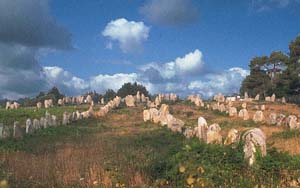
Carnac... a village near the Atlantic coast of Brittany in northwestern France, Carnac is famous as the site of more than 3,000 prehistoric stone monuments. The single standing stones (menhirs) and multistone clusters (dolmens) were hewn from local granite, now worn by time and weather and covered with white lichen. The stones were venerated by the Bretons (the Celtic people of Brittany).

5.17

blackguardise the whitestone...

5.16

unkalified...

Kali:
Although her presentation in the West is usually as simply dark and violent, Kali is a goddess with a long and complex history in Hinduism. Her earliest history as a creature of indiscriminate violence and wrath still has some influence, while more complex Tantric beliefs sometimes extend her role so far as to be the Ultimate Reality and Source of Being. Finally, the comparatively recent devotional movement largely conceives of Kali as a straightforwardly benevolent mother-goddess. Kali is associated with many devis (goddesses) as well as the deva (god) Shiva.

5.15

to the thunder of his arafatas...

Mount Arafat (sometimes known as Mount Arafah) (Arabic: جبل عرفات; transliterated: Jabal 'Arafat) is a granite hill east of Mecca. It is also known as Jabal ar-Rahmah or the Mountain of Mercy. The hill is the place the Prophet Muhammad delivered his farewell sermon to the Muslims who had accompanied him for the Hajj towards the end of his life. It reaches about 70 meters in height.

Pause: Considering Bloom...


Dublin city center 1930's street scene - Trams on O'Connell Street Bridge & a Guinness Barge on the River Liffey, making its way upriver to the nearby Guinness Brewery. The steam barges ferried beer barrels from the James Street brewery to Victoria Quay where the Guinness ships docked. Up until the late 1950's the barges were used extensively on Ireland's waterways to transport kegs of Guinness. Their funnels were hinged, enabling them to be lowered when travelling under the Liffey's bridges at high tides.

Dublin Coat of Arms


The Coat of Arms of the City of Dublin was first granted officially to the municipal authority, Dublin City Assembly in 1607. It includes the ancient device of the three castles, which has been the symbol of the city since the Middle Ages.

The three castles are shown on the 13th century Dublin City Seal as three watchtowers surrounding one of the gates of the medieval City Wall. In the central watchtower two sentries sound the alarm, while in each of the other two towers an archer stands with cross-bow at the ready. The scene is symbolic of the readiness of the citizens to defend the city.

With the passage of time, the three watchtowers became three separate castles, with three battlemented towers in each castle. Flames now appear from the towers in place of the sentries and archers. It is often supposed that the Castles are on fire, but in fact the flames symbolise zeal; they represent the zeal of the citizens in defence of Dublin.

5.6

Riesengeborg...

Karkonosze Mountains (pronounced kár-ko-no-she) in Polish or in Czech (known as Giant Mountains in English, or Riesengebirge in German) is a mountain range, part of the Sudetes in Central Europe.

5.5

Wassaily...

Vasily Buslaev: hero-warrior, 15th century Russian ballad cycle of Novgorod

T.Milushina. "Vasily Buslyaev" 1977 Kholui

In the rich trading city of Novgorod lived Buslay, a rich man who lived an honourable and peaceful life. When he was 90 his wife Amelfa Timofeyevna bore him a son whom he named Vasili. The father died before the boy was seven years old. The mother had her son taught by a master to read, write, and sing very well, but when he weas 12 years old Vasili had had enough of education, and developed to become Novgorod's strongest and cruel street-fighter. Furious citizens regularly came to visit his mother. She urged him to assemble a band of soldiers to fight the unbelievers as his father had done, instead of doing evil.

Vasili interpreted his mother's advice in his own way. He wrote down on strips of paper: "Anyone who wishes to eat and drink as much as he likes, come to me. Vasili Buslayev." He folded the strips of papers into arrows and shot them into the town. Then he took a large number of barrels of wine from his father's stores, filled up a beaker with the contents of a bucket and a half, and placed it outside. It did not take long for the guests to arrive. Vasili took hold of a club weighing 12 pud and said: "Anyone who can lift this beaker with one hand, drain it in one gulp, and withstand a blow of my club on his head without falling over can be my friend and may come in to celebrate with me." Everyone left discouraged, except for the latecomer Kostya Novotorzianien who managed to lift the beaker with one hand, drained it in one gulp, repeated this once again, and bore Vasili's blow on his head without falling over, merely saying: "I will just empty a third beaker."

The two lads entered the house and made friends. Then, through the window, they saw Potanya the Cripple approaching. He also achieved and endured what Kostya had achieved and endured. The next few days another 27 strong lads achieved and endured the same. Celebrating day after day, they formed Vasili's band of men. The hero continued to feed and clothe them generously. The people of Novgorod wondered where it would all lead.

During a meeting about this matter, a stranger struck his staff on the ground three times and suggested: "Let us too give a feast and not invite Vasili and his band." Of course, he and his followers will come anyway. Then we will offer the leader a flagon of green wine with the words:

"Anyone who is a friend of Great Novgorod, drain this flagon. If he accepts it, he obviously has no evil intentions towards us. If he refuses it, we should watch out."

They all agreed, and a great feast was prepared. Vasili and his band arrived uninvited, exactly as the stranger had predicted. The aggressive young fighter was offered a flagon of green wine with the words "For anyone who is a friend of the city." Vasili accepted the beaker and called out, "Long live Novgorod." He drank the wine in a single gulp, and everyone was relieved. However, befuddled by the alcohol, he became aggressive later in the evening and threatened: "Whatever you do, you are, and will always be fools. You will all be in my power and pay tribute to me."

The furious citizens doubted this. Then Vasili suggested holding a duel on the bridge over the Volchov between him and his band, on the one side, and an army of townspeople, on the other. If the latter won, they could take his head, but if he won, everything and everyone in Novgorod would belong to him. The drunken Vasili went home and boasted about this bet to his mother. He predicted: "Tomorrow will prove to all those unbelievers in Novgorod that Vasili Buslayev is the boss over everyone." His mother locked him up.

The next morning Vasili's band awaited their leader in vain, and then decided to fight the townspeople without him anyway. The band was heavily outnumbered and in danger of losing, but Amelfa Timofeyevna's housekeeper, who was doing the washing in the Volchov, saw what was happening to the band. She ran back home and freed Vasili from his bedroom. Hastily the hulk grabbed the axle of a cart, ran to the bridge over the Volchov and defeated the army of Novgorod. He went berserk to such an extent that his godfather, the kalika Ondronich

Piligrimitch was called from the Cyrille abbey nearby to negotiate. Perhaps Vasili would sign a peace treaty in return for a dish of pearls, a dish of silver, and a dish of gold. The monk was refused. Finally Vasili's mother was called and she persuaded her son to accept peace. Novgorod accepted Vasili Buslayev as mayor.

http://www.artrusse.ca/Byliny/buslaev.htm

5.5

There is no ancient gentlemen but gard'ners, ditchers, and grave-makers. They
hold up Adam's profession....

The Scripture says Adam digg'd. Could he dig without arms?

--Hamlet V.1.27-35: Clown

Saturday, February 11, 2006

Page 4.35-36-5.2


Woolworth Building (1913)


Eiffel Tower (1889)

baubletop...

Page 4.32

caligulate...

Gaius Julius Caesar Germanicus (August 31, 12 – January 24, 41), most commonly known as Caligula, was the third Roman Emperor and a member of the Julio-Claudian dynasty, ruling from 37 to 41. Caligula represents a turning point in the early history of the Principate. Known for his extreme extravagance, eccentricity, depravity and cruelty, he is remembered as a despot. He was assassinated in 41 by several of his own guards.

Unfortunately, Caligula's reign is the most poorly documented of the Julio-Claudian dynasty. The literary sources for these four years are meager, frequently anecdotal, and universally hostile. As a result, not only are many of the events of the reign unclear, but Caligula himself appears more as a caricature than a real person; a crazed megalomaniac given to capricious cruelty and hare-brained schemes. Caligula is often accused of having incestuous relationships with his sisters, most notably his younger sister Drusilla, but there is no credible evidence to support such claims either.

[St Patrick's father supposedly maintained lighthouse at Boulogne built by Caligula]
-Source: Fweet


Boulogne Tour d'Ordre Light...

The Tour d'Ordre -- a name believed to be a corruption of the Latin expression "turris ardens" ("fire tower") -- was built in the year 40 A.D. on orders of the Emperor Caligula, one of a number of pharos built at various points of the Roman Empire. It served as an aid to navigation for vessels crossing the English Channel. After the fall of the empire ca. 500 A.D., maritime trade declined and this lighthouse fell into disrepair along with many others. The Tour d'Ordre was restored as an aid to navigation for a brief period during the reign of Charlemagne, ca. 810. The fire at the top of the tower reportedly could be seen at Dover, on the other side of the English Channel. The tower disappeared in 1644 when the cliff on which it stood collapsed.

Page 4.32

Several Anglo-Saxon persons were named Ecgberht (or Ecgbert or Egbert):

Ecgberht of Kent (ruled 664–673)
Saint Egbert (died 729), hermit and missionary
Ecgbert, archbishop of York (died 766)
Egbert II of Kent (died c. 784)
Egbert of Lindisfarne (died 821)
Egbert of Wessex (ruled 802–839)
Ecgberht, Viking puppet 860s

Page 4.32

Childeric was the name of several Frankish kings:

Childeric I (c. 437- c. 482)
Childeric II (c. 653-673)
Childeric III (died about 751)

Page 4.32


Haroun al-Rashid figures in the third chapter of Ulysses, in a dream of Stephen:

"Wait. Open hallway. Street of harlots. Remember. Haroun al Raschid. I am almosting it."
Harun al-Rashid (Al-Rashid is Arabic for The Rightly Guided) (Arabic هارون الرشيد also spelled Harun ar-Rashid, Haroun al-Rashid or Haroon al Rasheed; English: Aaron the Upright; ca. 763 – March 24, 809) was the fifth and most famous Abbasid Caliph. Ruling from 786 until 809, his reign and the fabulous court over which he held sway are immortalized in The Book of One Thousand and One Nights.

Julian Köchert's painting of Harun al-Rashid (1864) receiving the delegation of Charlemagne demonstrates the latter's recognition of Harun al-Rashid as the most powerful man of his culture. The oil on canvas is located at Maximilianeum Foundation in Munich.

Musical Interlude

"Finnegan's Wake" is a song, called a street ballad, that arose perhaps in the 1850s. It is one of several mock-Irish stage songs that were very popular in 19th-century American vaudeville.


Tim Finnegan lived in Walkin Street,
A gentle Irishman mighty odd
He had a brogue both rich and sweet,
An' to rise in the world he carried a hod
You see he'd a sort of a tipplers way
but for the love for the liquor poor Tim was born
To help him on his way each day,
he'd a drop of the craythur every morn

Whack fol the dah now dance to yer partner
round the flure yer trotters shake
Bend an ear to the truth they tell ye,
we had lots of fun at Finnegan's Wake

One morning Tim got rather full,
his head felt heavy which made him shake
Fell from a ladder and he broke his skull,
and they carried him home his corpse to wake
Rolled him up in a nice clean sheet,
and laid him out upon the bed
A bottle of whiskey at his feet
and a barrel of porter at his head

His friends assembled at the wake,
and Widow Finnegan called for lunch
First she brought in tay and cake,
then pipes, tobacco and whiskey punch
Biddy O'Brien began to cry,
"Such a nice clean corpse, did you ever see,
Tim, auvreem! O, why did you die?",
"Will ye hould your gob?" said Paddy McGee

Then Maggie O'Connor took up the cry,
"O Biddy" says she "you're wrong, I'm sure"
Biddy gave her a belt in the gob
and sent her sprawling on the floor
Then the war did soon engage,
t'was woman to woman and man to man
Shillelagh law was all the rage
and a row and a ruction soon began

Mickey Maloney ducked his head
when a bucket of whiskey flew at him
It missed, and falling on the bed,
the liquor scattered over Tim
Now the spirits new life gave the corpse, my joy!
Tim jumped like a Trojan from the bed
Cryin will ye walup each girl and boy,
t'underin' Jaysus, do ye think I'm dead?"